
! Без рубрики
How to Exchange USDT for ETH Without Choosing the Wrong Network
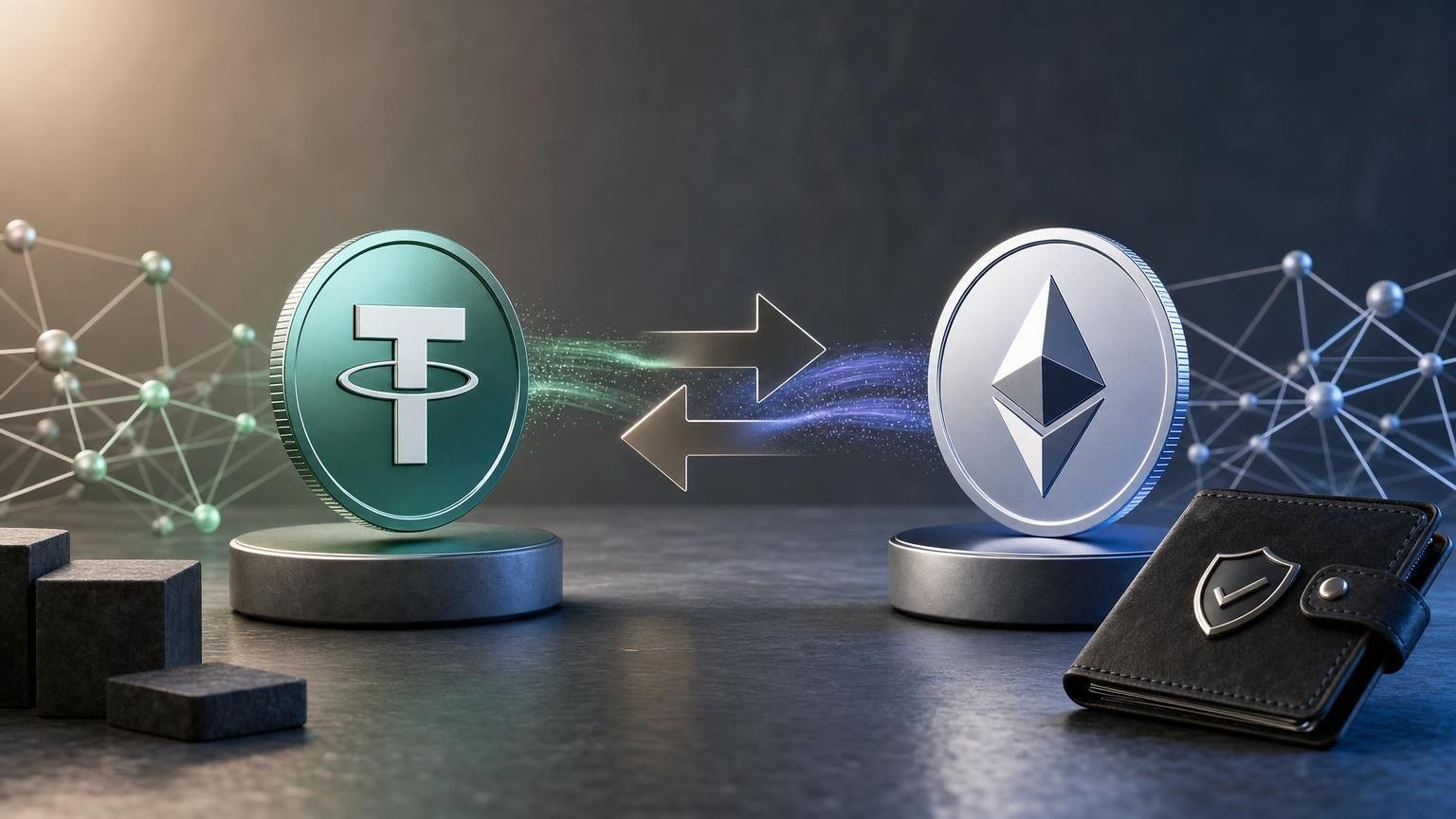
Exchanging USDT for ETH involves two separate checks: whether the service supports the intended conversion and whether the blockchain used to send or receive funds matches the order. USDT exists on multiple blockchains, so selecting the asset name alone is not enough. A transfer made through an unsupported network may not be credited, while a transaction sent to the wrong address is generally irreversible. [1]
This pre-operation review is designed to catch visible inconsistencies before funds move. It cannot remove volatility, technical failures, compliance reviews, wallet compromise, or human error. Treat every unresolved discrepancy as a reason to pause rather than as a detail to fix after sending.
Express Check: Stop Signals Before You Create an Order
| Stop signal | Why it matters | Action |
|---|---|---|
| The site was opened from an unsolicited message, advertisement, or support chat | A copied interface may collect credentials, replace deposit addresses, or request a seed phrase. | Stop. Close the page and reach the service through a previously verified bookmark or independently confirmed domain. |
| The order says USDT, but the sending wallet shows a different network from the deposit instructions | USDT is issued on several protocols, including Ethereum and Tron. The same ticker does not make these versions interchangeable. [2] | Stop. Select an explicitly supported network or create a new order with matching details. |
| The destination wallet cannot receive ETH on the network shown by the order | A familiar address format does not by itself prove that the service will credit the intended network. | Do not continue until the receiving wallet or platform confirms the exact network and asset. |
| The address changes after it is pasted | Clipboard malware, a compromised page, or manual error may have substituted the destination. | Stop immediately. Do not approve the transaction from that device until the cause is investigated. |
| Someone asks for a private key or seed phrase to “verify” or “recover” the exchange | A seed phrase is the master credential for a self-custody wallet. Legitimate support does not need it. [3] | End the conversation and secure the wallet from a trusted device. |
| The offer promises guaranteed profit, a fixed investment return, or risk-free ETH | Guaranteed-return claims are a recognized warning sign of crypto fraud. [4] | Do not send funds or connect a wallet. |
Two-Pass Pre-Operation Verification Card
Complete the first pass while reviewing the exchange route. Complete the second pass immediately before the irreversible action: sending USDT, approving a wallet transaction, or confirming a withdrawal. Do not rely on values remembered from the first pass.
Pass One: Verify the Operation Context
| What to verify | Independent confirmation | What a discrepancy means |
|---|---|---|
| Domain and session: the hostname is exact, the connection is secure, and the page was not reached through an unexpected message. | Compare it with a trusted bookmark, prior legitimate records, or the service’s independently verified official presence. Do not treat visual design as proof. | A spelling variation, extra subdomain, redirect, or unexplained certificate warning means stop. |
| Direction: the order shows USDT as the asset being sent and ETH as the asset being received. | Compare the order summary with the balances in the sending wallet and the intended receiving wallet. | Reversed assets or an unexpected intermediate asset means the order does not match the intended operation. Correct it before proceeding. |
| Pair availability: USDT-to-ETH is currently offered. | Check the live order interface rather than assuming that support for both assets guarantees every pair or route. | If the pair cannot be selected, do not improvise by sending to an address from an old order. Availability may change. |
| USDT source network: the network holding the USDT is identified correctly. | Check the wallet’s network selector, withdrawal page, or the relevant blockchain explorer. Confirm the network, not only the “USDT” label. | If the wallet holds USDT on one chain while the order accepts another, the transfer route is incompatible unless the service explicitly provides a supported cross-chain process. |
| Deposit network: the order explicitly accepts the same USDT network selected in the sending wallet. | Compare the network name in the order with the wallet’s withdrawal screen and current service instructions. Tether’s documentation confirms that USDT operates across multiple protocols. [1] | Different network names mean stop, even if the address looks technically valid. |
| ETH delivery network: the order states where ETH will be delivered, and the destination supports that network. | Use the receiving wallet or platform’s official deposit instructions. If it expects Ethereum Mainnet, do not substitute another EVM-compatible network merely because the address begins with “0x.” | If the order and destination name different networks, clarification is required before the order is funded. |
| Destination ownership and control: the ETH address belongs to the intended wallet or account. | Open the receiving wallet directly and use its receive function. For a custodial platform, generate or confirm the deposit details inside the authenticated account. | An address supplied only through chat, email, social media, or a third party should not be trusted. |
| Current conditions: displayed rate method, applicable fees, limits, amount rules, expiry conditions, and estimated output are visible and acceptable. | Use the current order screen and applicable service terms. Do not rely on a screenshot, advertisement, or earlier order. | Missing, inconsistent, or outdated conditions mean clarify. Do not assume the final amount or processing time. |
| Verification requirements: any requested checks are shown through the legitimate service channel. | Review the current requirements before creating or funding the order. They may depend on the operation and the results of compliance screening. | An unexpected request should be verified with official support. Do not send identity documents through an unverified messenger or attempt to bypass applicable controls. |
| Source of all critical data: addresses, networks, and order terms come from the active authenticated session. | Compare the order identifier and instructions across the order page and any official notification generated for that same order. | Conflicting instructions indicate possible phishing, an expired order, or a changed session. Stop until one authoritative set of details is established. |
Pass Two: Recheck Immediately Before Sending
| What to verify | Independent confirmation | What a discrepancy means |
|---|---|---|
| USDT deposit address: compare the full address shown in the wallet with the current order, not only the first and last characters. | Read it from both screens or compare a safely generated QR code with the decoded value shown by the wallet. | Any changed character means stop. Delete the recipient entry and investigate possible clipboard substitution. |
| Network selector: the withdrawal network still matches the order’s accepted USDT network. | Read the network name on the wallet’s final confirmation screen. Do not infer it from the address format. | A mismatch means the transaction must not be signed or submitted. |
| Memo, Tag, or additional identifier: include one only if the active order explicitly requires it. | Compare the field with the current order and the sending platform’s confirmation screen. | A required identifier that is missing or altered may prevent automatic crediting. If no identifier is displayed, do not invent one. |
| Amount sent: the entered USDT amount follows the order’s current amount instructions. | Compare the wallet amount with the live order summary and account for any withdrawal fee displayed by the sending platform. | If the net amount arriving would differ from the required amount, pause and recalculate rather than sending an additional transfer blindly. |
| Expected ETH: the current displayed output and calculation method remain acceptable. | Refresh or reopen the active order summary before approval, especially if the order has an expiry or floating terms. | A changed output may reflect updated market conditions, fees, or an expired quote. Decide based on the new terms; do not assume an earlier figure still applies. |
| ETH receiving address: the final order still contains the intended destination. | Compare it again with the receiving wallet opened independently on a trusted device. | An unexplained change means stop. Ethereum transactions sent to a wrong address generally cannot be reversed. [5] |
| Wallet confirmation: the final screen describes the intended transfer rather than an unrelated token approval, contract interaction, or unlimited permission. | Read the asset, recipient, network, amount, and action type shown by the wallet. Reject unreadable or unexpected signing requests. | If the wallet asks to sign a different action, cancel it and return to the verified order page. |
| Order state: the order is active and still expects payment. | Confirm the order identifier, status, and payment instructions in the same session immediately before sending. | An expired, cancelled, completed, or replaced order must not receive a new payment unless official instructions explicitly say otherwise. |
After both passes are complete, one possible next step is to check the current USDT-to-ETH exchange conditions. The service supports USDT and ETH among its listed assets, but the specific pair, network, direction, and requirements must still be confirmed in the live interface.
Classify the Result Without Treating It as a Guarantee
- Continue the verification: the domain, asset direction, source network, deposit network, destination network, addresses, amount, and active order state agree. This permits the process to move to the next check; it does not guarantee successful or risk-free completion.
- Clarification required: a fee is unclear, the expected amount changed, the order expired, an additional identifier is ambiguous, or verification requirements appeared unexpectedly. Pause and obtain confirmation through an independently verified service channel.
- Stop: the network differs, an address changes after pasting, the destination cannot receive the stated network, the site requests a seed phrase, or instructions arrive from an unverified person. Do not send a test amount to diagnose a clearly incompatible route.
Control Route Before, During, and After the Exchange
Before the Transfer
- Open the receiving ETH wallet independently and confirm its network.
- Create a fresh order and record its non-secret identifier.
- Complete both verification passes.
- Close unrelated browser tabs, remote-access tools, and unsolicited support chats.
- If the risk justifies it and the service conditions allow it, consider a small preliminary transaction. A successful test can reduce address-entry risk, but it does not prove that a later transfer will have identical terms or processing results.
While Waiting
Keep the order page available and monitor the sending transaction through the correct network’s block explorer. A blockchain explorer can show the transaction hash, status, sender, recipient, transferred token, amount, fee, block, and timestamp. [6] Do not create a replacement order or resend USDT merely because the interface has not updated immediately.
Separate three states that are often confused: the wallet has prepared the transaction, the network has recorded it, and the exchange has credited it. A completed withdrawal notice from the sending platform is not by itself proof that the receiving service has accepted the deposit.
After Confirmation
Check the ETH transaction on the network specified by the order. Match the destination address and amount with the completed order record. Do not judge success only by a wallet’s fiat-value display, which may update separately from the on-chain balance.
If the Status Is Delayed, the Amount Differs, or Data Changes
| Situation | Diagnostic route |
|---|---|
| The USDT transaction has no txid | Check the sending wallet or platform for a queued, rejected, or unsubmitted withdrawal. Without a txid, there may be no on-chain transaction to inspect. |
| The txid exists but the transaction is pending | Open it in an explorer for the network actually used. Check the status, sender, recipient, token, amount, and whether the transaction has entered a block. |
| The transaction succeeded on-chain but the order is not credited | Confirm that the txid belongs to the accepted network and that the address, token contract, amount, and required Memo or Tag match the order. Contact verified support with the order identifier and txid, not with wallet secrets. |
| The ETH amount differs from the earlier estimate | Compare the completed order with its rate method, applicable fees, amount received, and any expiry condition. Preserve the original order record before refreshing or starting another operation. |
| The deposit address or terms changed after order creation | Do not send to either version until the active order state is confirmed. Save non-sensitive evidence of the discrepancy and use an independently verified support channel. |
| USDT was sent through the wrong network or to the wrong address | Do not make another transfer to “unlock” the first one. Collect the order identifier, txid, network, destination, token, and timestamp, then contact the relevant wallet, platform, or service. Recovery may be technically impossible or unavailable; no return should be assumed. |
Threats Directly Relevant to a USDT-to-ETH Exchange
- Phishing: a false exchange page can reproduce branding while changing the deposit address. Verify the domain before creating the order and again before sending.
- Address substitution: clipboard malware may replace a copied address. Compare the complete value after pasting and on the wallet’s final confirmation screen. Payment-request data requires integrity because changing the recipient or amount can redirect an irreversible transaction. [7]
- Wrong network: USDT on Ethereum, Tron, or another supported protocol is not automatically interchangeable at the deposit stage. Both sides must explicitly support the same route.
- Seed-phrase theft: never disclose a seed phrase, private key, or wallet backup to an exchange, support agent, recovery service, or website form. Anyone with the phrase may control the wallet. [3]
- Guaranteed-return claims: a routine exchange should not be presented as a guaranteed investment opportunity. Promises to multiply the resulting ETH or provide risk-free returns are reasons to disengage. [4]
Minimal Record to Keep After the Operation
Retain only the data needed to trace the transaction and communicate with legitimate support:
- order identifier;
- USDT sending network and ETH receiving network;
- USDT deposit txid and ETH delivery txid, when available;
- asset amounts shown in the final order record;
- order creation and completion timestamps;
- the non-secret sending and receiving public addresses;
- a copy or screenshot of the final order status with unnecessary personal information removed.
Do not store a seed phrase, private key, password, authentication code, identity-document image, or unrelated personal information alongside the transaction record. The useful audit trail is the order identifier plus verifiable on-chain data—not the credentials that control the wallet.
